

“Yellow Dress”: Deeper Layers revealed
For those who experienced “Yellow Dress” at its live premiere, this article dives deeper into the film’s meaning. Using responses from its’ Creative Director and leading actresses, we answer 6 key questions. 1. Why “Yellow Dress”? 2. Why Dance as the Centerpiece? 3. Why her Grandmother as the Villain? 4. Why not a Man as the Savior? 5. Why Molly as the Drug? 6. Then lastly, what inspired the ending of the film?
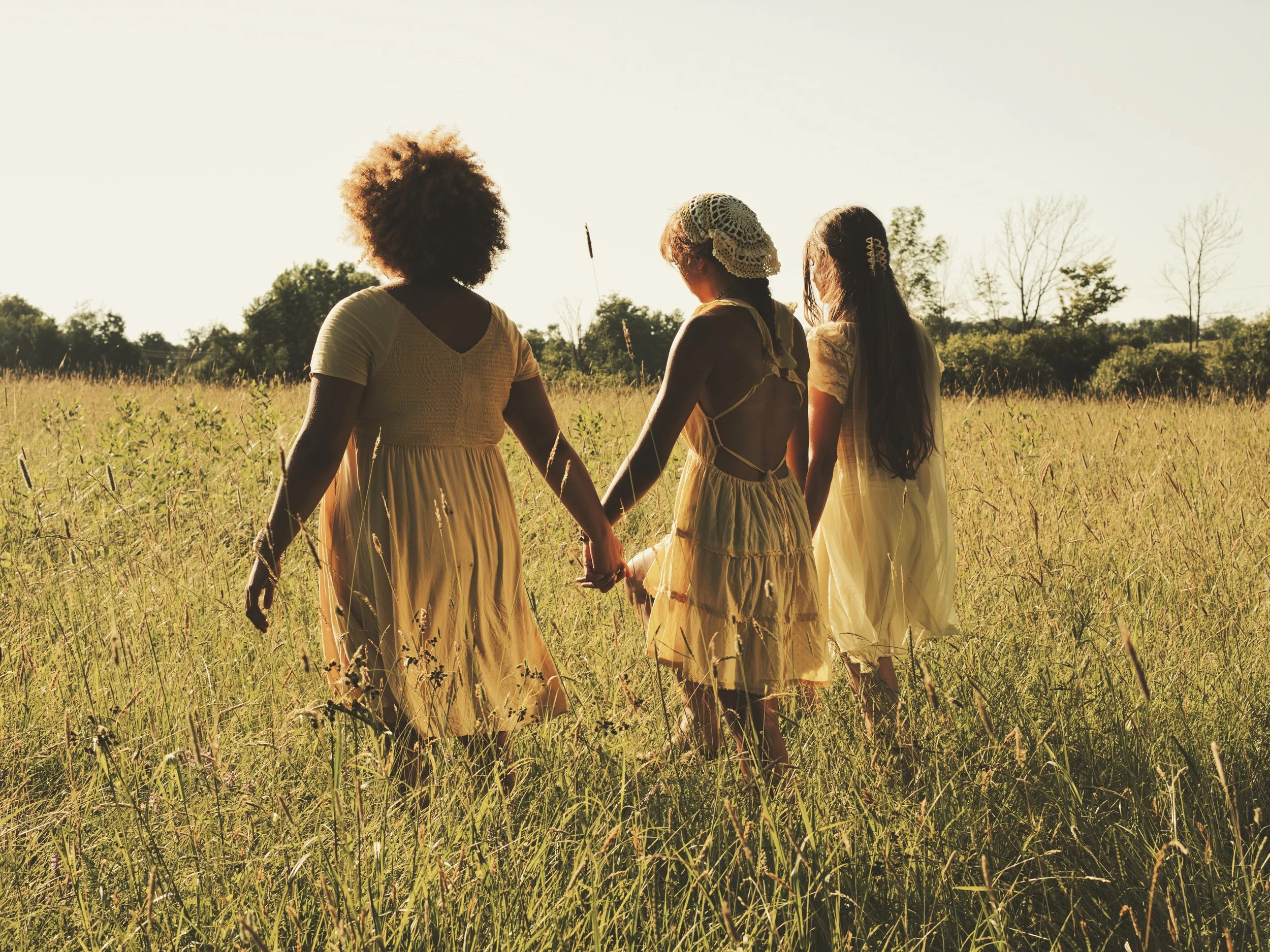
Why “Yellow Dress” as the title?
We explored this question in our first article on “Yellow Dress”, click this link to see our articles and read it for yourself!
Photo by Jean Carlos
2. Why Dance as a centerpiece?
Olive, I know that you have experiences as a dancer, so I want to ask you a little bit about your experience as a dancer, how did you bring that into your character?
Olive: Well, of course my character is a dancer, and throughout the film, her trauma is expressed within those dancing scenes. The emotions that she's battling… through and navigating are shown within the movements. I was doing that improv, I was just imagining, you know, where I had been in my head at different parts of my life and just removing myself from the physical world and being in that place. And I feel like that's what she does a lot when she's not dancing to - in order to cope. I think that the idea of disassociating through movement and through your emotion is something that's reflected even outside of those dance scenes.
Mars: I would say that having dance in Yellow Dress was very important just because I grew up dancing and I know that it was something that was very close to Olive. I didn't want to do dance in a way where it was just movement and to just show talent. I really wanted dance to resemble a state of mind and like how Olive said, the dissociation. You know we go to so many different places when we dissociate, but the Red Room was Olive's place to dissociate for whatever that she was enduring.
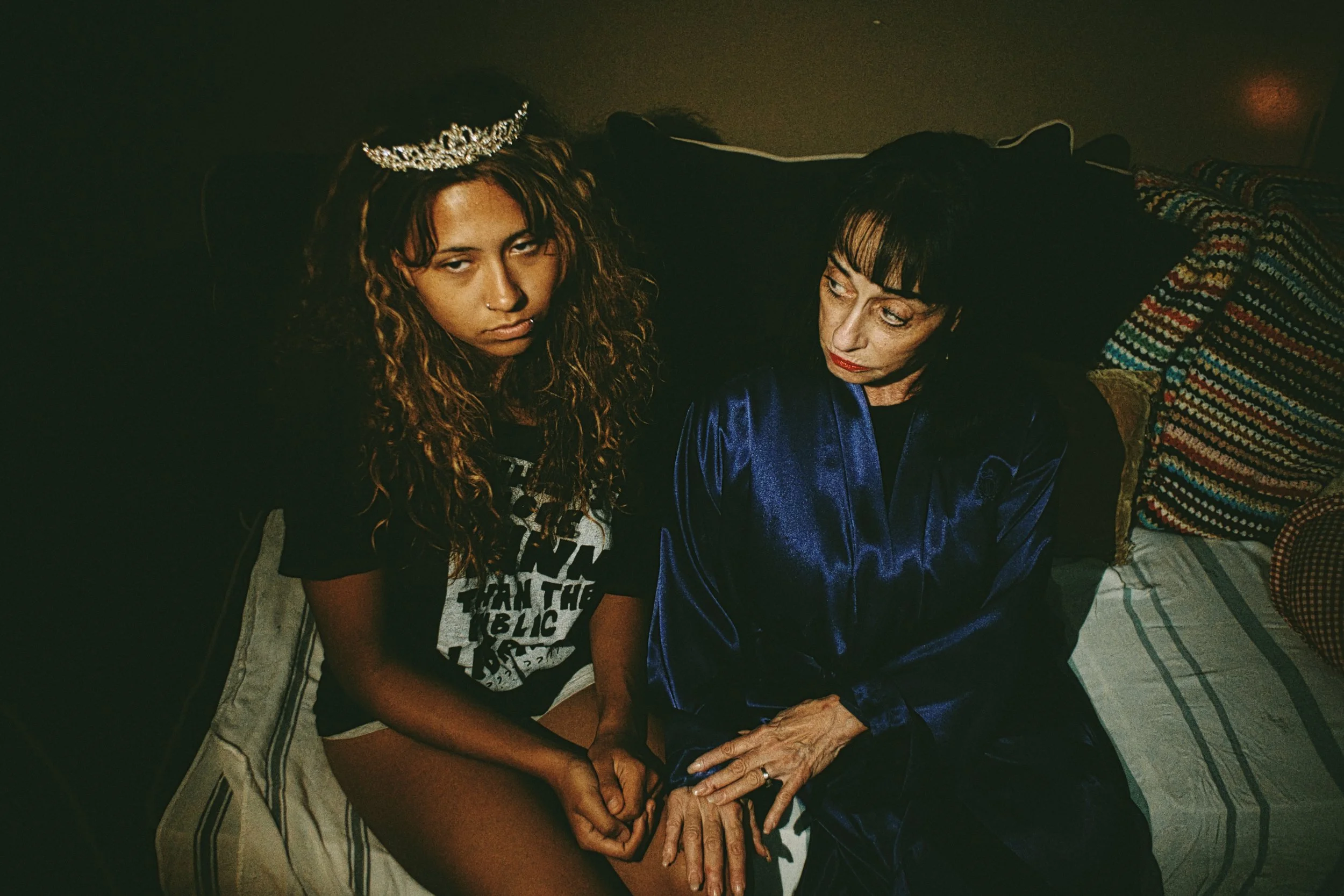
3. Why her grandmother as the villain?
Olive sits with her Grandmother - Photo by Jean Carlos
When you chose the conflict, you chose Olive and her grandmother. What made you decide to pick that dynamic versus mother to daughter or even, even teacher to student?
Mars: So I knew that it was gonna be a situation between Olive and someone that she was supposed to trust and supposed to love.If I'm gonna be completely honest, Terry, the one that played Olive's Grandma, she was presented to me. Terry is a Buffalo icon. She was in Buffalo 66. She was the head of the talking crowd of the Buffalo Bills, in the 1980s. Same with Olive, from the moment I saw her, I fell in love with her and I was like, “I have to get her into this film no matter what”. Terry is actually someone that grew up dancing and grew up as a dance instructor as well. So it was more so having the cards that were dealt to me and then making it work.So if Terry was a little bit younger, Terry could have been a mother, you know, it was just more so that with Terry's age, knowing that I needed some sort of dynamic, it just all fell into my lap.
Having Terry be the grandmother, what inspired you to bring in Olive's mother story into that?
Mars: I wanted there to not be confusion. I wanted Olive's mother in the story to at least be this sense of hope or honesty… a memory that Olive can always go back to. I wanted to kind of show why Terry, or why the grandma, treats Olive that the way that she does… it's because she couldn't do what she wanted to do with her own daughter…. And I think… people that are supposed to be the ones that we're supposed to trust and the ones that we're supposed to love us, are the ones that sometimes end up hurting us. And I think that's like a huge thing that I wanted to put into the story. I think a lot of people may think that, you know, abuse and trauma come from strangers or from people that you just meet one day and then that's what it is. Usually, [and] unfortunately [it] comes from the people that are in charge of us and are supposed to take care of us and love us.So just wanted to make sure I highlight that, that that was like a huge thing that I wanted to put out there.
One of the main moments of confrontation between Olive and her grandmother was actually on the phone. What was your decision on making that not an in-person confrontation?
Mars:I think it's just more powerful Olive being alone… It probably would have been cool to have the Grandma being in that moment, but I think it just hit harder for me of just only seeing Olive. It doesn't matter what the Grandma was saying- that wouldn't have added substance to the scene. Olive’s acting and reacting is what the scene was.
Olive: I also think that scene ties us back into the very beginning of the film.When Olive is looking at her phone right after dance and she's looking at the texts upon texts that are coming in. It shows that connection to the phone that their relationship is built on, and seeing that disconnected moment really like just resonates within the rest of their relationship- that's how they communicate.
4. Why not a man as the savior?
For the monologue Inoticed that the grandmother, references that Olive's mother rebelled against her and [that] her title was a “slut” and her rebellious verb was “going to get fucked”. In this case it wasn't a man that was Olive's rebellion, but her friends. It's interesting to think that the [rebellious] verb in this sense would be to “go play”, because that's where she's going.
Mars: I think the reason why… I didn't want to make it where Olive was running away with a guy, you know, because I think that kind of cheapens the whole story. I didn't want it to be a romance, I wanted it to be about girlhood and childhoodand really shining a light on when my blood family wasn't there for me. Who was there to save me? And it was my friends.
Olive: If I can add on to that, I feel like it was such a more important message to carry out that she was running back to herself. She wasn't running away from herself. She wasn't running away from her family, from her legacy - that she had from her mother and from her grandmother. She was running closer to something that was true to her, and away from something that was forced upon her.
Syd: Or even trying to find herself. I feel like at such a young age, you don't know yourself and especially a character like Olive, she didn't have a childhood to define herself and figure out what that meant. I think that was only a space that was maybe within her friends that she could have access to that true version of herself.
Olive: I felt like I've grown up, similar to Mars, rushing to grow and rushing to leave youth. So her character forced me to embrace my youth, and to play, and to take pride and not feel weak for being young.
5. Why Molly as the drug?
Why choose molly as the drug for the catalyst for Olive’s emotional reveal?
Mars: What drew me to Molly was definitely my own lived experience to be honest. I feel like MDMA is definitely a drug that makes you feel a lot, but also takes a lot from you. I felt like there have there was gonna have to be a moment where Olive was gonna have to just break down. I think with MDMA your emotions and your senses are so heightened- so even that little touch of Syd just trying to make sure that she was okay, was gonna just make her break down no matter what. I felt like just from growing up and honestly, taking Molly and being a 19 year old girl, that was something that I had to put into the film. Even in the breakdown scene where Olive is breaking down on doing drugs - I'm sorry if my parents watch this - but there was definitely a moment in time where I was in a parking lot with a friend and I was coming off of the high off a drug and I just broke down and just spilled my truth. That was like the first time I felt like I was really spilling my truth.
Syd: And feeling free.
Mars: And feeling free, you know, and just allowing the emotions and everything to unravel. That moment being 19 years old was something that has always stuck with me and I wanted to be able to, you know, put that into Yellow Dress somehow.
Syd: Yeah, and just the dark side of drugs. You take these drugs to get a high, but you don’t know as a kid that you’re gonna hit a low of lows. And sometimes the low for people that have that trauma, it can be what makes you face that trauma and finally admit to yourself and the people that you care about that you went through something.
Mars: Yeah. And like the scenes after that, like really show like when they're getting the ice cream and that whole montage -that was really supposed to show like what the comedown of like a Molly trip feels like- going through the motions and just trying to stay alive.
The Molly scene itself is gorgeous - What inspired you to approach that scene in your way?
Mars: Yeah, because it could have been in any way, you know, like it literally could have just been them super high at the concert. I was definitely like juggling and doing this like 1970s, like super like acid out sort of vibe, but I think if you were to watch the Molly performance scene without knowing that it was a film, it looks like a Mars Angel BB project. It's got the alien colored girls, they got the monochromatic looks on, and we're listening to some FKA twigs dancing around. That shock was on purpose. I wanted to take us out of that world for a second because I think Yellow Dress is so realistic. I wanted to really add this fantasy approach to it to be like, “hey, guys, I could do this too”. It doesn't have to just be all serious and real. I want to make it a little surreal because I feel like that's what Mars Angel BB is - it is putting real life into surreal fantasy.
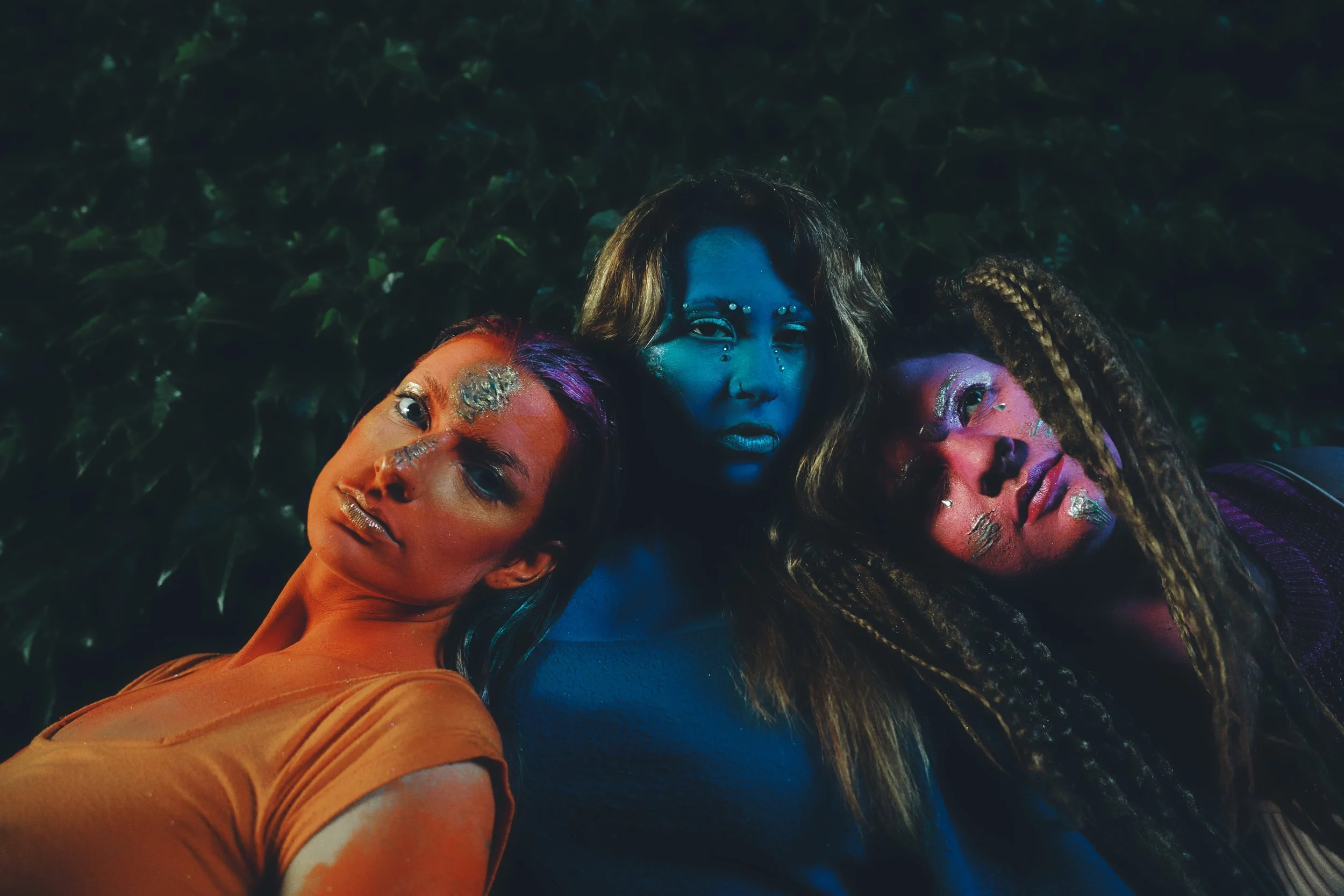
Molly Scene - From Left to Right: Syd, Olive, Tai - Photo by Jean Carlos
I was gonna ask y'all, what was your, what was your favorite part of shooting that scene?
Syd: We were in the makeup chairs for a few hours at that point. We only had so much time and we had people waiting. As soon as we finished, it was cameras - people- go! It was a very vulnerable experience, and that added to our experience of being on a drug. Everyone's watching you have your insides turn out and you become the most vulnerable and I feel like that experience of being under the lights of like a bunch of people [with] silence [that] we couldn't even really see who was watching. We had to kind of just be in our bodies and be with each other.
Mars: Yeah, that was definitely one of the more challenging scenes for me to be completely honest. Just in the sense that the location was supposed to be somewhere completely different. We were supposed to be like in these like green hills and they're supposed to be like running around and stuff like that - but that takes having a generator with like lights. So we needed to be somewhere we could still plug in lights. Thankfully, Avenir Cine, the production studio, [was where] we were doing our makeup and we were able to find a little alleyway. Thank God it had the like greenery - I don't know what would have happened if it was brick.
Syd: Yeah, like what I learned from watching you is [that] when you're making a film, it's not about having it all planned out. It's about what's around you and what you have and just making it work. I think that's really beautiful.
Is there anything other scenes you remember [being like] “Oh, fuck, we got to figure this out” or “We have to change our approach”?
Mars: Yeah, I feel like that happened a few times like on set. I think sometimes it happened too when I was in pre-production, working in the garage where I thought one thing was going to be that way and then it wasn't. I would have to say that the party scene was probably like the most challenging day, in the sense that there was 5 to 6 scenes that I knew that needed to be shot that day. I think in the regular movie industry world, they probably would have broken up that party scene into like 3 to 4 days. But we did that within like 13 hours just because I don't want to waste people's time… I had everything there in that moment that it was like, “let's just do it all”, you know? We had to go between 5 different worlds and it was definitely like, “Wow”. [And} it was hard in the sense that everyone was looking at me… for the answers.
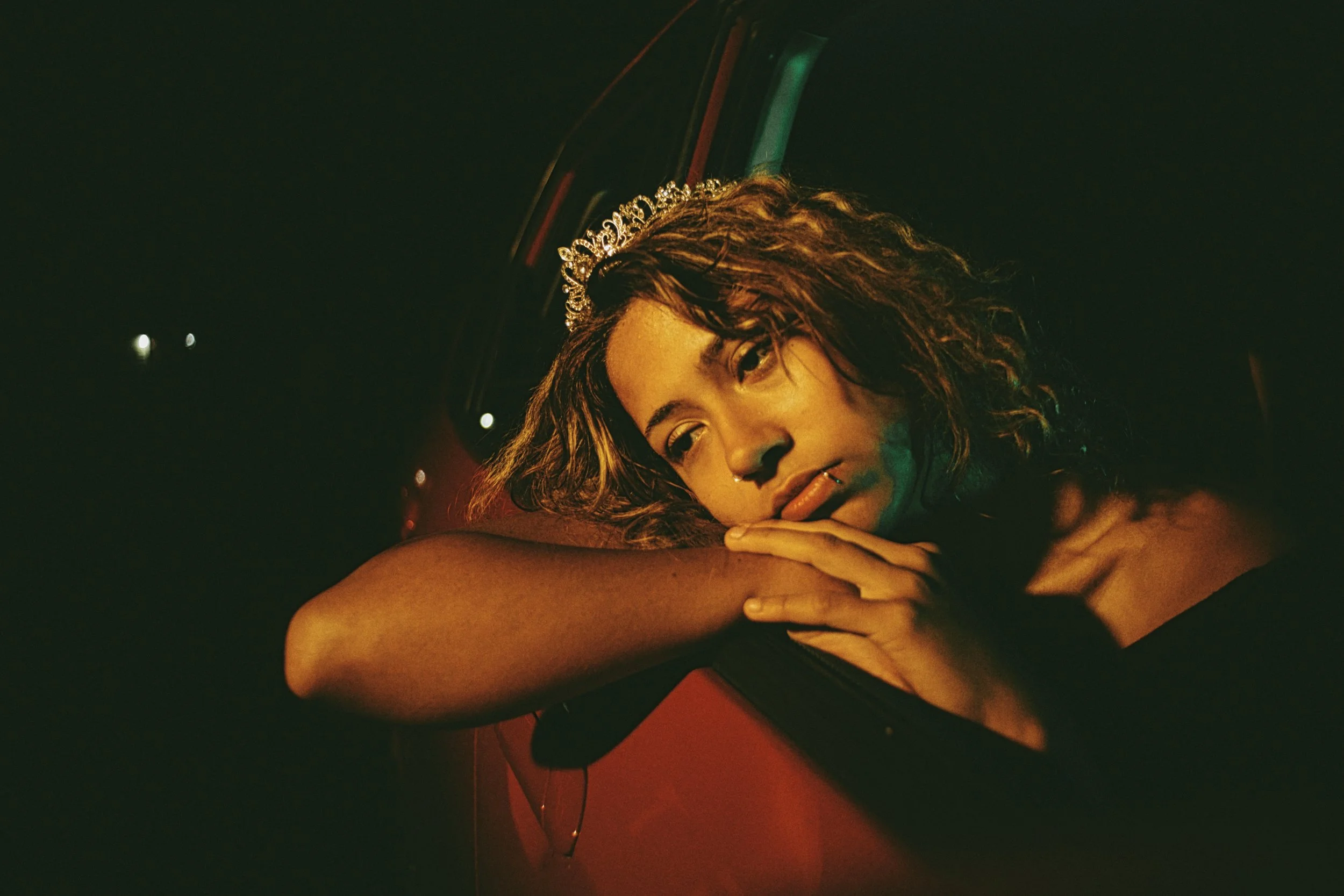
6. Why the ending?
Final Car Scene - Photo by Jean Carlos
I loved the ending scene in the car… but I couldn't help but wonder, where did you see yourselves headed to in that car?
Olive: I think we're going back to Sid's house. Yeah, that was our safe Haven, like “We need to get back to Base A”.
Mars: There's definitely like an element that I think I wanted to explore a little bit when I first started writing, Yellow Dress, and that was getting justice. Were they on their way to go tell on Olive's Grandma and go tell on that whole trafficking situation? Were they going to Miami? But that's the beauty in it, is that they were going anywhere that the audience wants them to go to, you know, until... I mean, they don't.
Is the ending meant to be up for interpretation or is that supposed to be a clear destination? Clear destination, for sure.
Lastly, what influenced your decision to have them die at the end?
Mars: I’ve always been drawn to films that don’t necessarily end with everyone winning - those have stayed with me the most because it feels very truthful to life. When I was developing the end of Yellow Dress, it wasn’t for shock value but more to have people feel a narrative that I unfortunately carried for a while - “life isn’t always happy endings”. Thankfully I’ve been slowly unlearning it, but there is some truth in that. Sometimes life is confusing and sometimes it’s dark, and sometimes things don’t end that way you had hoped they would. I wanted to audience to reflect that feeling rather than keeping everyone comfortable. The Virgin Suicides, Anora, Florida Project, The Neon Demon, and Springer Breakers are some of the films that have stuck with me forever- they weren’t afraid to leave the audience feeling unresolved.
Even though my perspective on life has now evolved since writing Yellow Dress, that emotional narrative was very real for me at the time.
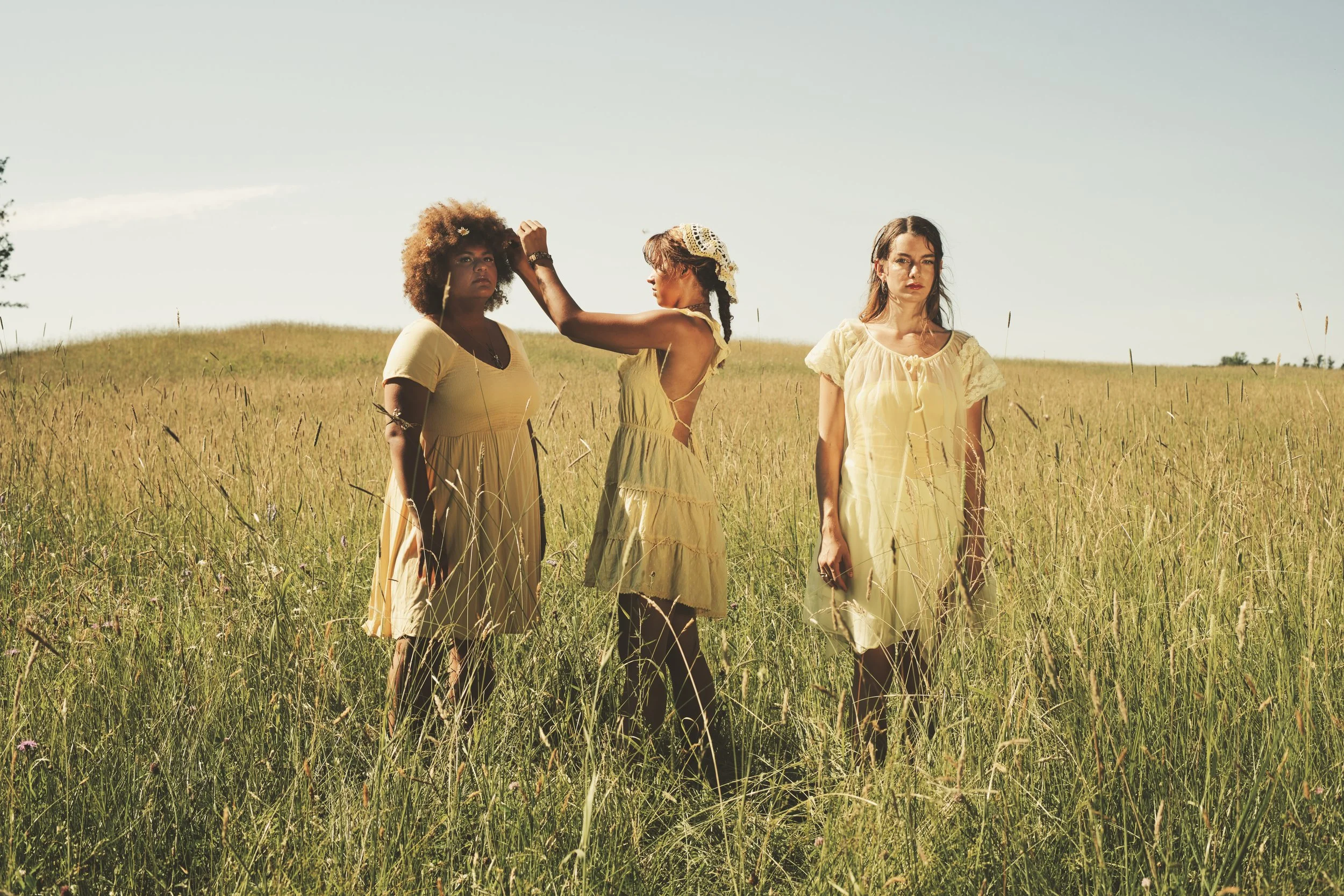
The Three Characters in the Afterlife - Photo by Jean Carlos